

STEWART LIBRARY ANNUAL REPORT FY2026
Stewart Library continues to play an important role in campus student success and completion efforts, especially in the area of affordability, personalized educational experiences, and sense of belonging. We made progress on both long-term and annual goals in FY2026. Highlights include:
- Piloted an embedded librarian model in ENGL 2010 to replace the formerly required general education information literacy course.
- Continued progress on expanding the use of library materials as part of course materials affordability.
- Developed metrics to better track the impact of Open Educational Resources (OER) on student cost savings.
- Completed a survey of students belonging to library spaces.
- Developed a long-term library budget outlook for collections and student employment.
2026 also marked our first year of operations as the Library and Academic Support unit following the merger of the library and Academic Support Centers and Programs in July 2025. Our primary goal for this first year was simply to get to know each other and explore opportunities for collaboration that benefit from our distinct and shared areas of expertise and our mutual commitment to student success. Through ongoing conversations and cross-departmental observation, we identified several areas for ongoing collaboration, including planning for the eventual move of the Writing Center into the library and exploring a more integrated writing and research help service. We are also collaborating to better market and connect the Davis Library and Tutoring and Writing Center services.
GOAL 1: ACCESS, RETENTION, AND COMPLETION
Make substantial contributions to the WSU access, retention, and completion goals through affordability initiatives, student support services, and responsive, student-centered instructional practices.
Outcomes
- Increase the adoption of OER and other no- and low-cost course materials by 10% annually. (Excellent progress).
- By the end of FY2025, develop and implement a plan to assess the impact of OER/course materials and technology lending initiatives on student success. (Good progress; goal extended to FY2027.).
- By the end of FY2026 create an information literacy (IL) strategic plan that addresses the scaffolding of IL instruction across the curriculum. (Good progress; goal extended to FY2027.).
- By the end of FY2027, establish peer learning and other specialized student supports in composition and other key general education, developmental, and gateway courses. (Early-stage progress).
Related FY26 annual goals:
- Finalize metrics and methods and complete an initial assessment of the impact of grant-funded OER projects on affordability and student success.
- Pilot changes to the information literacy instruction program and launch a new research help service in light of the end of the general education information literacy requirement.
- Align collection development priorities with a stable base budget that addresses annual publisher price increases.
Highlights
- The library partially met its annual goal related to course materials affordability. We established standard cost-saving formulas that will enable us to track long-term impact. We did not complete an initial assessment of whether OER and other no-cost course materials have an impact on student success metrics because the underlying adoption data remains inconsistent. The Course Materials Dashboard is maturing and we will explore how we might use this data for assessment during FY27.
The library met its target of a 10% annual increase in the adoption of OER and no-cost library materials, categorized as Other Adoptions in the Course Materials dashboard (Table 1). The year-over-year increase has declined after a substantial increase in 2024. There was a concerted effort to get faculty to submit more accurate adoptions for library and other no-cost materials prior to 2024, so this year's decrease in the rate of no-cost adoptions was expected. There was a similar trend in the share of OER versus Other Adoptions. Most no-cost adoptions prior to 2026 were OER because of the heavy investment in grants before 2024. In the last two years, the library expanded its outreach to promote the adoption of library materials, resulting in a large increase in the number of Other Adoptions in 2026 (increasing from 100 to 557). Library materials and other no-cost adoptions represent an increasingly larger share of the total no-cost adoptions, increasing from 9% in 2025 to 42% in 2026.
Year Sections with No-Cost Adoptions Percent Change AY22 59 – AY23 118 100% AY24 849 619% AY25 1103 30% AY26 1331 21% Table 1: Percentage Increase in No-Cost Adoptions 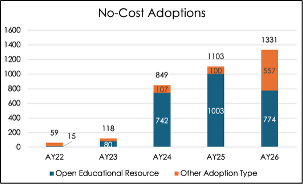
Figure 1: Number and share of OER and other no-cost course materials adoptions, 2022-2026 - The Resource Sharing and Course Materials department received an Innovation and Improvement grant for OER maintenance projects. Past recipients of OER creation and adaptation grants were invited to apply for funding to update their OER course materials, including updating content, adding learning activities, remediating content to meet accessibility requirements, and/or migrating content into a different platform. Eight projects were completed. See Appendix A.
- The Resource Sharing and Course Materials department also funded and facilitated the completion of seven OER adoption, adaptation, and creation grants. The cumulative ROI on OER grants funded since 2021 was $21 in savings for students for every dollar invested. If these OER continue to be used with similar enrollments, the ROI increases to $26 in AY2027 and $33 in AY2028.
- The Teaching and Information Services (TIS) Department made good progress on the goal of developing a strategic approach to scaffolding information literacy across the curriculum by piloting an embedded model in ENGL 2010. Library faculty and TIS staff developed a series of online content and in-person lessons that were tightly integrated with the ENGL 2010 writing curriculum and OER textbook. Library faculty and staff facilitated the in-person sessions and participated on Canvas via a new librarian role that enabled them to facilitate discussions and communicate with students via Canvas messages. At the end of the spring semester, the department assessed a random sample of student research papers or other artifacts from ENGL 2010 courses that had an embedded librarian and those that did not, as well as some artifacts from the sunsetting LIBS 1704 course. Students in the embedded librarian sections performed at a higher level than students without a librarian and performed nearly as well as students in the LIBS 1704 course. They achieved the appropriate, emerging level of competency on all of the information literacy learning outcomes. Because the pilot year was a success, the department will work with the English Department to make improvements and expand the number of sections with the embedded information literacy curriculum.
- The Teaching and Information Services Department met with our new Learning Support colleagues and benefited from their expertise in peer learning. Writing Center and Learning Support staff shared their approach to training tutors, particularly writing tutors, in specialized pedagogical methods for peer learning. TIS members and the Writing Center Coordinator and lead tutors also participated in initial architectural design planning for bringing the Writing Center into the library building. They continue to work with architects on plans while simultaneously exploring ideas about how to merge writing tutoring and research help into a more integrated experience for students.
- The User Services department continued to contribute to access, retention, and completion goals through its technology lending program. With the support of funding from the central administration, we were able to replace 40 aging laptops and eliminate the waiting list for semester-long laptop loans. Feedback from students continues to be positive with a common theme of how laptop loans help bridge financial gaps.
- The Collection Management team continued to refine its approach to building and maintaining a collection focused on supporting the teaching mission of the university, while also supporting faculty and student research needs. We piloted a new approach to book and media budgets for each subject area, providing a baseline budget that accounts for research-intensive areas, such as those with graduate programs. We reserved a portion of the collection budget for special projects, such as updating a specific subject area more comprehensively. During the past year, subject librarians completed a major weeding of the print reference collection. The 2026 special project budget was dedicated to purchasing new print reference materials to replace outdated items.
- The Course Materials team worked with the bookstore to experiment with ways to quickly investigate whether items on the course materials adoption list could be purchased as unlimited-user eBooks. We identified nine unique textbook titles across 11 sections taught by seven faculty members. Five of these faculty members responded to outreach asking them to officially adopt the library eBook. In FY2027, subject librarians and the course materials team will reach out to faculty to identify possible eBook licenses prior to the adoption deadline as a part of the Wildcat Access automatic charge program rollout.
- The library administration completed a five-year budget forecast that identified budget gaps caused by annual increases in prices for library electronic resources, the rise in student employee wages, and new investments in course materials as part of Wildcat Access.
GOAL 2: PERSONAL CONNECTIONS AND ACADEMIC EXCELLENCE
Enhance student connection to the WSU community and promote high impact educational experiences through personalized research help and instruction, student employment, and library programming, service, and spaces.
Outcomes
- Engagement with the library, as measured by building use, in-person and virtual service use, in-person and virtual program attendance, and other forms of engagement (internships, volunteering, etc.) will increase by 2% per year (Excellent Progress).
- The percentage of in-depth research consultations with students will increase by 5% per year (Needs improvement and better data).
- The percentage of in-depth curricular or research consultations with non-library faculty will increase by 5% per year (Needs improvement and better data).
- The percentage of students who receive specialized information instruction in their majors will increase by 5% per year (Needs improvement and better data).
- By the end of FY2026, complete an assessment of student safety and belonging in the library. By the end of FY2028, address areas of concerns and assess for improvement. (Excellent Progress).
Related annual goals:
- Develop a space and service plan that incorporates findings from the 2025 needs assessment, in collaboration with campus partners in Academic Support Centers and Programs, the computer labs, and the Digital District.
- Complete a student survey of belonging in library spaces.
Highlights
- Gate count rebounded from a slight dip in FY2025, from 244,209 to 255,541. The weekly snapshot, taken in the third week of September, rose to 9,000, from 7,949 in FY2025. This confirms anecdotal evidence that the library is busier during the fall and spring semesters than it has been in previous years.
The library continued popular programming designed to promote student engagement. Highlights include the annual Halloween Night at the Library, a collaboration with several student clubs and academic departments (such as Botany and Zoology) to offer an engaging evening of costumes, craft making, and fun activities. Overall attendance at all of the student engagement programs was around 1,300.
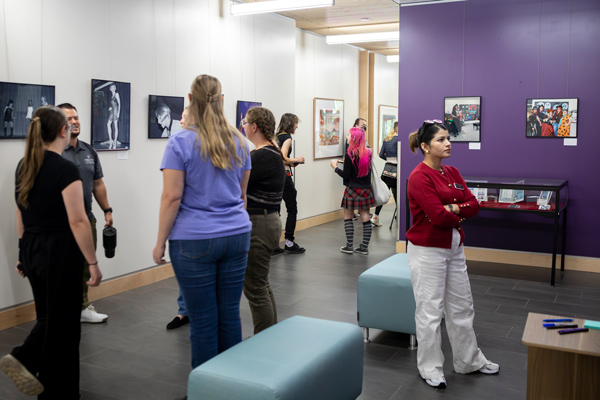
- In Fall 2025, the library partnered with the Interior Design department on their annual design charrette challenge. Erich Goeckeritz prepared a design brief that described the spaces that the library wants to refresh with a student-centered perspective. Ninety students participated and generated more than a dozen concept plans, including renderings, 3D models, and cost analysis and budgets. They presented these designs at a high-profile public event and the library is using elements of these designs for future space planning.
- Library staff, faculty, and student workers engaged in a series of brainstorming sessions, using feedback from previous user studies and the Interior Design charrette. Library leadership prioritized remodeling the northeast side of the second floor upon learning the Food Pantry was relocating and that there was support for moving the Writing Center into the library. We will work with architects on a design for this space and with central administration to secure funding, with the goal of construction in Summer 2027 and opening in Fall 2027. We will then assess other changes that we can make to the second floor to activate the lobby entrance and create more soft seating and comfortable study environment in the area that currently houses print periodicals.
- Ernesto Hernandez, from the Teaching and Information Services Department, revised an existing survey instrument to assess students' sense of belonging and safety in library spaces and the helpfulness of select library services. The survey was sent to a random sample of WSU students by the Office of Institutional Effectiveness during the 2026 spring semester. One hundred thirty-four students responded. While the sample size was too small to measure statistically significant differences between demographic groups, a preliminary analysis of the descriptive statistics suggests that students generally find the library a welcoming space and view library services as helpful. There are several services that students were less aware of, including research help services and interlibrary loan. A more thorough analysis will inform follow-up assessments and outreach efforts.
GOAL 3: COMMUNITY ANCHOR MISSION
Contribute to the well-being and strength of the campus and local communities in which we are embedded.
Outcomes
- The library will establish and/or deepen one community-based partnership annually, as measured by documented engagement through meetings, convening, and/or formal programming. (Excellent progress)
- By the end of FY2028, Special Collections and University Archives (SCUA) will have increased the number of collections, including oral histories, documenting traditionally underrepresented populations, by 20%. (Excellent progress)
Highlights
- Government documents are an important part of the collection that serves both academic and community needs. In FY2026, the library shifted to a digital-only paradigm, which makes this important information easier to access. Approximately 30,000 print items were removed from the shelves. Patrons can now browse a Government Information resource webpage for digital access to the most used resources. Many of the more specialized print items were added to the Utah State University collection, the congressionally designated repository for the U.S. Western region. In their new home, these items can continue serving patrons seeking federal research materials in print at a single, centralized location. The Stewart Library remains a participant in the Federal Depository Library Program, with digital-only status.
- SCUA developed a year-long exhibit, More than Mormon Muffins, that explores northern Utah foodways, including a satellite exhibit at the Museums at Union Station. The exhibit was very popular with library patrons who interacted with the exhibit by providing recipes. The project also included a collaboration with Studio 76 students – offering them a high-impact educational experience as they produce documentary film content related to the exhibit.
- SCUA's Digital Initiatives team continued to expand the Ogden at its Core project, working with the Japanese Buddhist Temple, Embry AME Church, and Brith Sholem communities to digitize their records. They also completed the project of digitizing 100 years of Weber High School yearbooks and scrapbooks, which will help celebrate the school's centennial in 2027.
- In February, we co-hosted a talk by Shamichael Hallman (author of Meet Me at the Library) in partnership with the Weber County Public Library. Eighty people attended the event.
- Student interns from the History Department processed 54 archival collections, making them accessible to the public while supporting student learning in the Public History program.
- SCUA secured a $100,000 grant to digitize the Browning Arms collection.
- See the complete SCUA Annual Report in Appendix B.
GOALS AND STRATEGY DEVELOPMENT FOR 2026 - 2027
- Continue to assess and improve the ENGL 2010 embedded information literacy program and further develop a strategic plan for integrating information literacy, including AI literacy, across the curriculum.
- Work with the Writing Center to explore ways to expand peer learning opportunities for information literacy, including the feasibility of cross-training writing tutors to provide basic information literacy tutoring. Continue to explore service design for a potential integrated Writing and Research Help Center.
- Complete the architectural design of the Writing Center and second-floor public areas, and secure funding for construction.
- Collaborate with the bookstore and other campus partners on the implementation of Wildcat Access, the automatic charge program for course materials launching for Spring 2027 Semester. Explore ways to increase the formal adoption of library-provided materials as part of this program.
- Work with Academic Support Centers and Programs partners on a plan to strengthen student employment practices, focusing on mentoring and the development of durable skills.
- Continue to coordinate with campus administration on a long-term budget plan to address price increases in library materials and additional commitments to support course material affordability.
DATA
The data below represents a selection of the metrics that the library reports to the Association of College and Research Libraries (ACRL) annual statistical survey and IPEDS (Integrated Postsecondary Education Data System), combined with locally reported data. We also use peer comparisons, when available, to assess library usage, institutional and budget support, and service interactions.
Trends
The following reports three- to five-year trends for metrics related to library collections and services.
Collection Size
There was a decline in the number of print titles as the result of a major weeding project to remove outdated material from the collection – particularly reference books – where publishing has shifted to electronic titles. The rise in the number of electronic book titles in our collection is a result of weeding the reference collection, the library's efforts to license more eBooks as course materials, and general publishing trends. While the library continues to reduce its print serial subscriptions, we have increased the number of electronic serial titles. A change in how vendors count serial titles within large database packages also contributed to the significant increase in electronic serial titles.
| Collection type | FY2024 | FY2025 | FY2026 |
|---|---|---|---|
| Physical Book Titles | 287,456 | 329,914 | 308,235 |
| Electronic Book Titles | 648,287 | 665,599 | 928,845 |
| Print Serial Titles | 4,427 | 4,268 | 3,797 |
| Electronic Serials | 137,788 | 125,219 | 153,121 |
| Physical Media | 27,884 | 27,911 | 27,558 |
| Electronic Media | 203,798 | 182,322 | 185,095 |
| Databases | 443 | 448 | 456 |
Circulation/Usage
The standards for counting usage of electronic materials changed in FY2026. The new standard methodology includes more open access titles and is a more accurate depiction of usage and accounts for the substantial increase since FY2025. The continued decline in print book circulation since FY2025 (when equipment lending was removed from the statistics) is something to watch in order to balance user needs for an effective mix of print and electronic materials. Additional weeding and acquisition of new print titles might also be warranted to increase the value of the print collection to library users.
| Circulation/Usage Type | FY2024 | FY2025 | FY2026 |
|---|---|---|---|
| Total Physical Circulation | 13,774 | 9,148 | 7,850 |
| Total Digital/Electronic Book and Media Usage | 64,693 | 854,264 | 1,308,707 |
| Total Electronic Serial/Journal Usage | 316,359 | 270,299 | 496,101 |
Interlibrary Loan (ILL)
The provision of materials to other libraries has steadily decreased over the past few years. This decline is likely a reflection of strategic journal cancellations, resulting in fewer materials to lend. We have also cleaned up our holdings information, which has decreased requests for titles that we do not actually have. Given that large research libraries are better equipped to fulfill this ILL function, this is not a major concern. Our focus is maintaining materials unique to Weber State and collaborating with our partner libraries in the Utah Academic Library Consortium on strategic collection development to ensure that we are participating in the larger ecosystem effectively. Patron demand for materials from other libraries increased only slightly from FY2024 after a brief dip in FY2025, suggesting that journal cancellations are not creating a barrier to quick access to materials for WSU students, faculty, and staff.
| Interlibrary Loan category | FY2024 | FY2025 | FY2026 |
|---|---|---|---|
| Total interlibrary loans and documents provided to other libraries. | 4,105 | 2,030 | 1,782 |
| Total Interlibrary Loans and documents received. | 1,769 | 1,548 | 1,816 |
Library Help and Research Consultations
The number of general library and research help transactions increased to FY2024 levels, but the number of in-depth research consultations declined. There have been challenges with all library employees participating in accurate record-keeping, which will be an area of improvement in FY2027.
| Type of Assistance | FY2024 | FY2025 | FY2026 |
|---|---|---|---|
| Library and Research Help (basic assistance in using the library, finding a book, navigating library resources, etc.) | 3,182 | 2,421 | 3,159 |
| In-Depth Research Consultations | 245 | 493 | 292 |
OER Grants and ROI
The ROI for the grant program increases every semester that a grant-funded OER continues in use.
| Cumulative OER metrics 2021-2026 | Total |
|---|---|
| Total grant projects awarded | 62 |
| Student enrollment in impacted courses | 68,035 |
| Funding awarded | $ 461,225 |
| Estimated cumulative savings | $ 8,578,923 |
| Projected annual savings | $ 3,353,197 |
| ROI (student $ saved per $ invested in grants) | $ 20.61 |
Textbook Lending Library
Checkouts declined in FY2026, which might be related to a shift to more electronic textbooks and Day One Access digital adoptions. We will assess the usage of the print textbook library/course reserves in FY2027 and adjust our collection strategy, especially in light of the rollout of Wildcat Access in Spring 2027.
| Year | # of books added | Cost | Checkouts |
|---|---|---|---|
| FY22 | 554 | $ 43,700 | 926 |
| FY23 | 461 | $ 31,585 | 1,429 |
| FY24 | 208 | $ 14,455 | 1,820 |
| FY25 | 127 | $ 8,627 | 2,006 |
| FY26 | 203 | $ 14,655 | 1,402 |
Equipment Lending
The library successfully replaced some outdated laptops, bringing our inventory into better alignment with student demand. There were no turnaways for equipment requests in FY2026. We shifted a portion of our inventory from semester-long to one-week laptops loans to balance demand. The updated equipment likely reduced the number of checkouts because fewer students returned older laptops for a better working replacement in the middle of the semester.
| Device | # of devices | FY26 change in # of devices | Total requests fulfilled (no turnaways) | FY26 change in fulfilled requests | Checkouts | FY26 change in checkouts |
|---|---|---|---|---|---|---|
| Semester laptops | 315 | -36 | 845 | -79 | 845 | -59 |
| 1-week laptops | 35 | +25 | 257 | 61 | 257 | -108 |
| 1-week hotspots | 27 | +5 | 508 | 184 | 505 | +130 |
Library Visits (Gate count)
The total annual gate count bounced back from a slight decrease in FY2025. The one-week snapshot gate count, taken in the third week of September, rose to 9,000 from 7,949.
| FY2021 | FY2022 | FY2023 | FY2024 | FY2025 | FY2026 |
|---|---|---|---|---|---|
| 31,954 | 173,198 | 206,108 | 255,884 | 244,209 | 255,541 |
Peer Comparisons
Data is from the ACRL Benchmark Survey from FY24 because of a data lag. The peer group is the WSU defined peer institutions.
Building Usage
The library was open 91 hours per week during the fall and spring semesters. This was the same as the median of our peers.
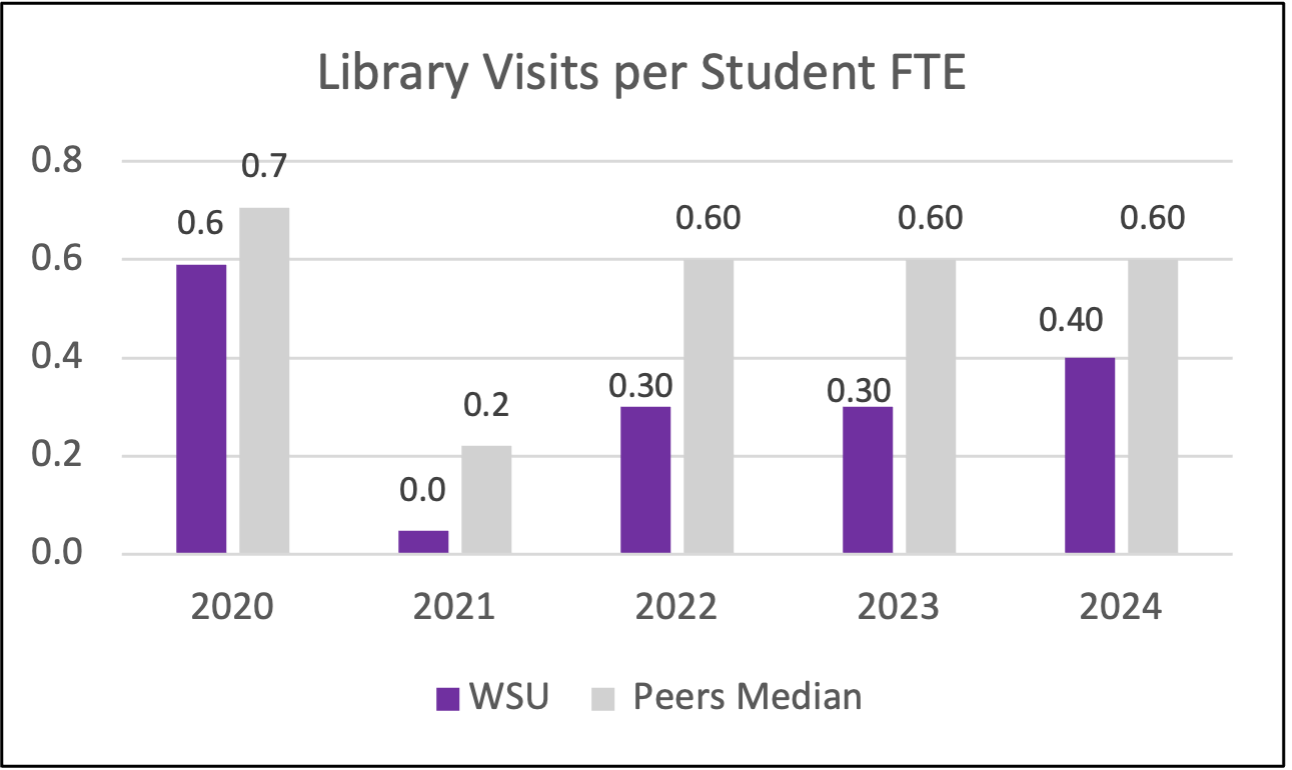
Library usage – as measured by annual visits per student FTE – was below our peers in FY2024 (0.4 compared to 0.6), but it continues on a slight upward trend.
Budget and Institutional Support
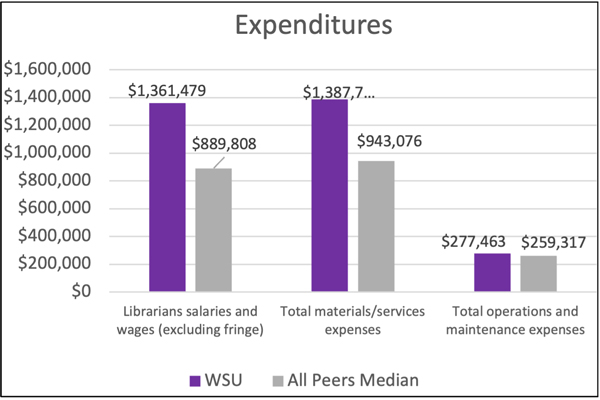
Total expenditures were higher than the median of our peers in all categories (salaries, materials and services, and operations and maintenance).
Library expenditures as a percentage of total institutional expenditures have remained fairly constant (1.7% - 1.8%) since 2019. The rolling 3-year average (1.7%) is slightly higher than our peers (1.5%).
Expenditures per student FTE were lower than our peers, $224 compared to $327.
Personnel
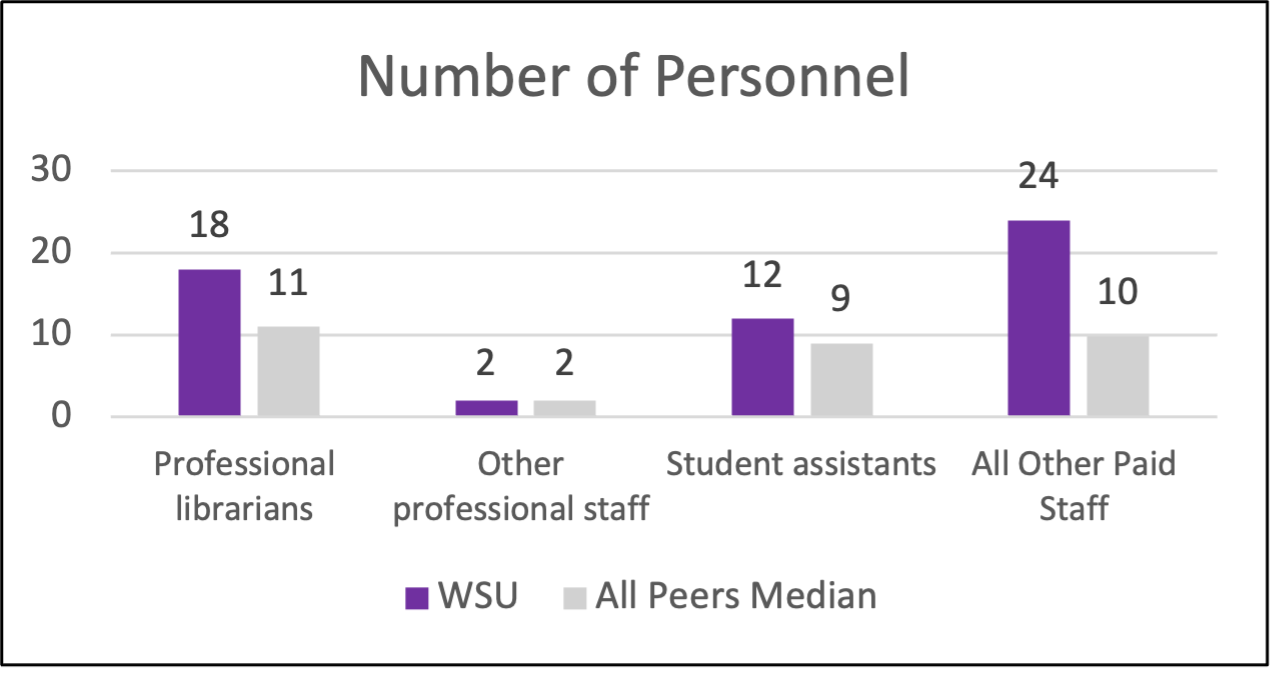
Stewart Library employs more personnel, including student assistants, than our peers (56 versus 32). The student to personnel FTE ratio is higher than our peers, 344 (WSU) versus 332 (peers). The student to professional librarian ratio is 1,070 at WSU versus 965 for our peers. This means that fewer personnel serve more students at WSU.
Collection Size
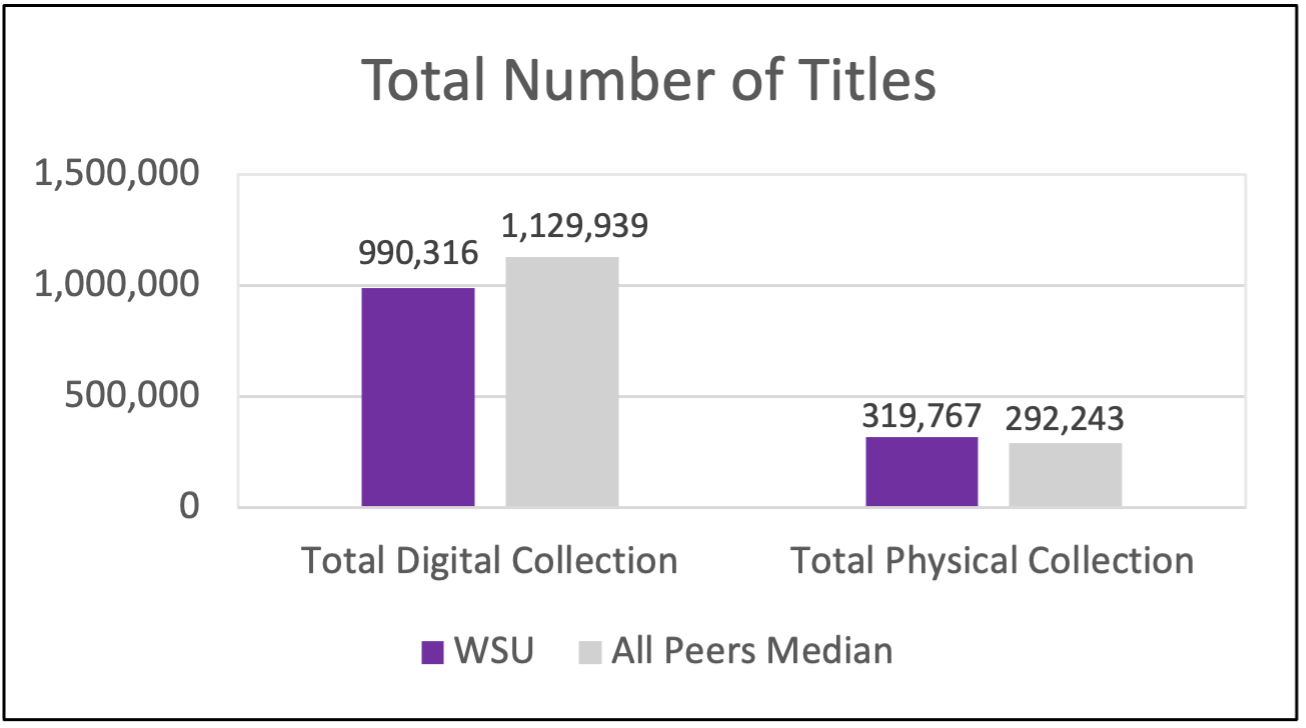
The total size of the library's digital collection is smaller than our peers.
The number of physical titles was slightly higher than our peers.
The number of digital and physical titles per student FTE was smaller than our peers: 68 versus 134.
Collection Usage
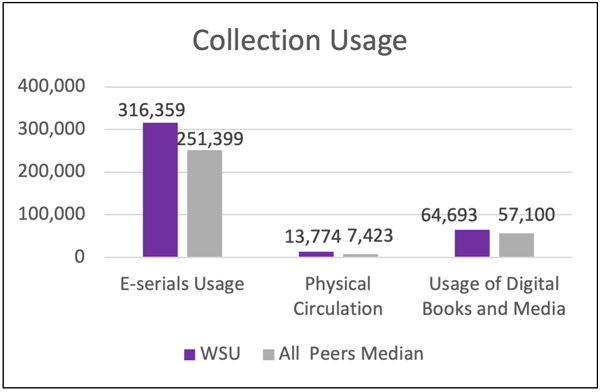
Total collection usage, as measured by digital views and downloads and physical item checkouts, was higher than our peers.
Usage per student FTE was lower than our peers: 21 versus 30 uses per FTE.
Patron Interactions and Instruction
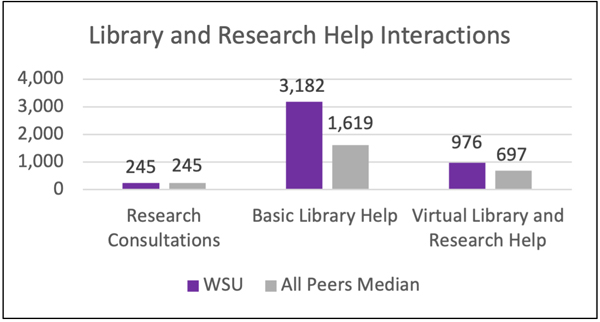
The total number of help interactions was higher than our peers, particularly in the area of basic library and research help, such as how to locate a book.
The number of interactions per student FTE was virtually the same as our peers: 0.22 versus 0.23.
The number of research consultations was lower than our peers: 0.013 versus 0.023.
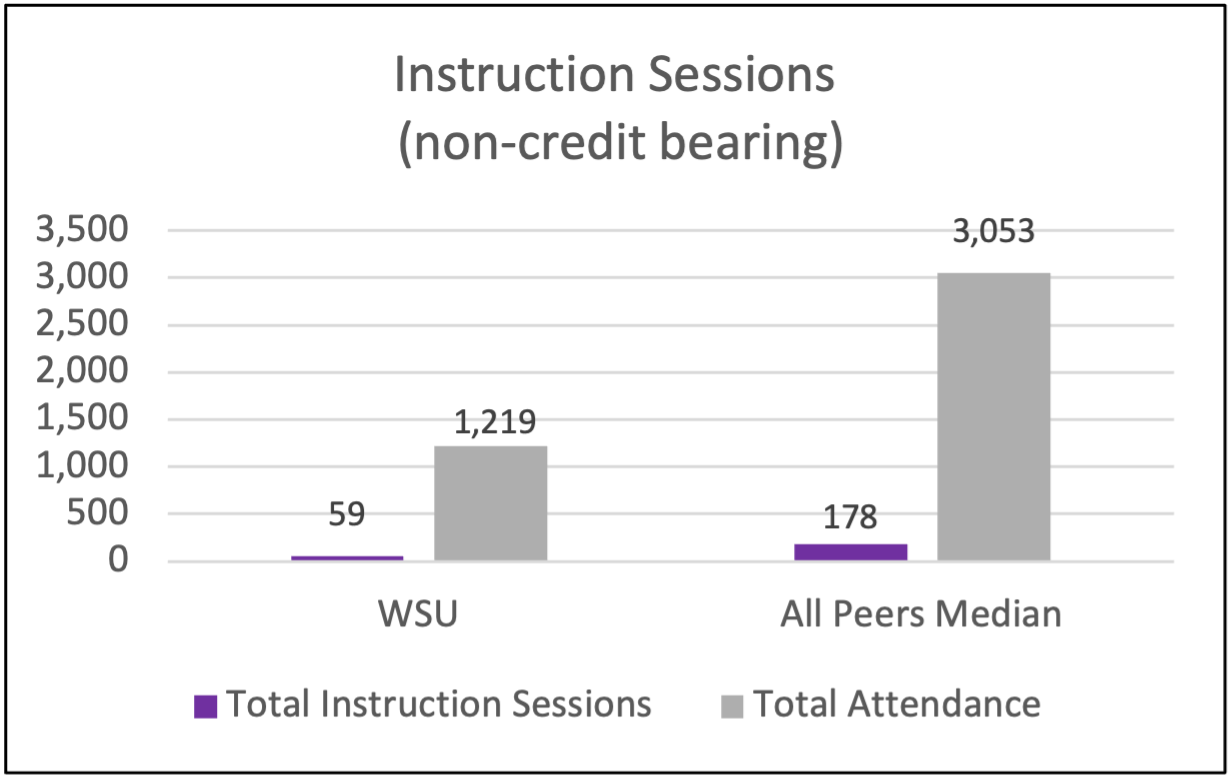
The number of instruction sessions was substantially lower than our peers.
In FY2024, most information literacy instruction took place via a required general education course. This course is no longer a general education requirement. Instruction sessions across the curriculum should increase in the future.
There was also a probable data error in FY2024 because some library faculty did not report instruction sessions consistently.
APPENDIX A: INNOVATION AND IMPROVEMENT GRANT OER PROJECTS
In 2026, the Stewart Library received funds through an Innovation & Improvement grant to support a one-time program for the maintenance of existing OER materials. This typically involved updating content, adding learning activities, remediating content to meet accessibility requirements, or migrating content into a different platform.
FYE 1105 – Foundations of College Success
This project adapted an existing OER that has been used on campus for a number of years. Content was migrated into Pressbooks and tailored specifically to Weber State University in the use of images and examples of support services.
ENGL 2010 – Intermediate College Writing
An OER textbook for this course was recently completed through a past grant opportunity. Now that it has been used in the classroom, feedback from faculty was used to improve the text. Instructor resources were added to better support the department curriculum.
EDUC 4345 – Elementary Integrated Arts Methods
This project updated a faculty-designed website. Accessibility and user experience were improved, learning resources were updated, and images were replaced to use openly licensed options. While the site was previously publicly available at no cost, it has now also been officially assigned an open license.
CS 4110 – Formal Languages and Algorithms
An existing OER textbook was updated to better meet accessibility requirements and incorporate student feedback requesting more detailed explanations for code examples. It was also modified to allow future updates to be pushed more seamlessly into the live version of the book.
PHIL 1250 – Critical Thinking
Lecture notes and other materials previously hosted in RedShelf were moved into Pressbooks. The text is now free to students, and the faculty can revise the text with greater ease.
Multiple Neuroscience Courses
Several resources hosted in Pressbooks – originally created by a former WSU faculty member but still utilized on campus – were missing metadata and attributions on many of the images. This project successfully resolved those omissions by filling in the missing information.
Multiple Electrical & Computer Engineering Courses
An OER homework platform designed to meet the needs of WSU's ECE courses was given an update. The codebase was upgraded to enhance security and integrate mobile support features, and the interface was modified to improve the overall user experience for both instructors and students.
APPENDIX B: SPECIAL COLLECTIONS & UNIVERSITY ARCHIVES ANNUAL REPORT
by Jamie Weeks, Head of Special Collections and University Archives
Over the past year, Special Collections & University Archives (SCUA) has continued to expand access to historical resources through strategic digitization initiatives, collaborative community partnerships, exhibitions, and archival processing. These efforts support the department's mission to preserve, document and provide access to the diverse histories of Weber State University and Northern Utah.
A significant accomplishment this year was the collaborative development of the year-long exhibition, More Than Mormon Muffins, that explores the rich food traditions and cultural heritage of Northern Utah. A companion traveling exhibition was displayed at the Museums at Union Station from March through July 2026. Building on this work, a student-centered collaboration with Weber State University's Studio 76 faculty and students is currently underway, providing learning opportunities while further developing the project.
Community engagement remained a central focus of the department's outreach efforts. SCUA hosted a community scanning event at the Marriott-Slaterville City Building, providing residents with an opportunity to preserve and share historical photographs and documents while contributing to the growth of the university's archival collections. Department staff also participated in several community events, including Día de los Muertos, Juneteenth, the opening of the Museum of Utah, and Peoples of Weber County.
The Digital Initiatives team continued to expand the Ogden at its Core digital collection through partnerships with the Japanese Buddhist Temple, Embry AME Church, and Brith Sholem community. The team also completed the digitization of 54 years (1927–1971) of the Weber High School yearbooks and scrapbooks to support and commemorate the school's upcoming centennial celebration in 2027.
Through strong donor relationships and collaborative fundraising efforts, SCUA secured a $100,000 gift from the Browning family to support the digitization of the Browning Arms collection. This investment has enabled the department to hire three student employees dedicated to advancing this important preservation initiative.
SCUA's online presence continued to expand, with the department's Facebook audience increasing by more than 1,000 followers. This growth brings its total following to over 3,000 and expands opportunities to share collections, programs, and historical content with the public.
The SCUA eBook collection grew by an additional 205 titles and 71 oral histories, with the department now providing access to 3,577 transcribed digital monographs. Oral histories remain among the most frequently accessed resources in the digital collections, demonstrating a sustained public interest in firsthand accounts of regional history. Student employees and history interns continue to play an essential role in advancing the department's mission. During the past year, history student interns processed 54 significant archival collections, making them publicly accessible through the SCUA online finding aids. Student employees also provided critical support for digitization, metadata creation, collection rehousing, and the daily operations that sustain the department's archival preservation and access initiatives.